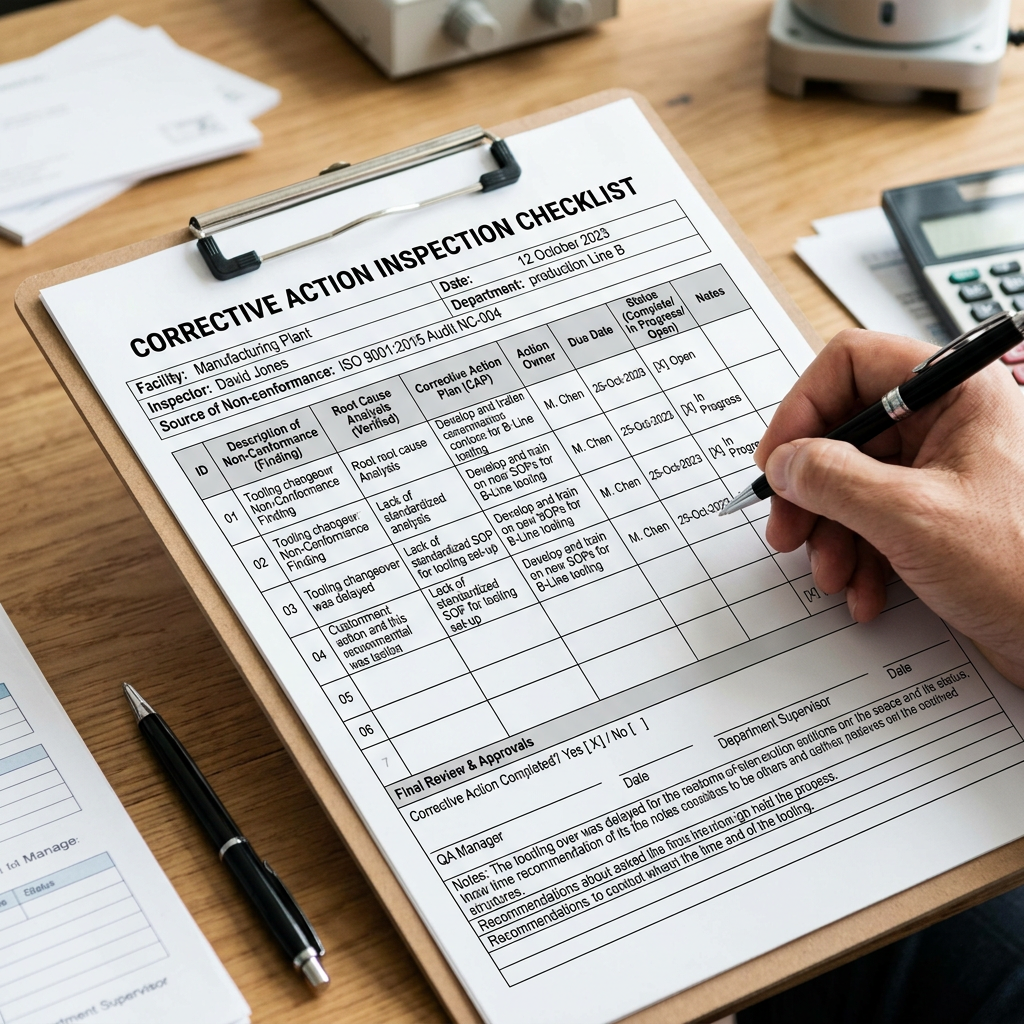
Every inspection reveals something.
A missing record. An overdue maintenance item. A process that is not being followed. A condition that creates unnecessary risk.
The inspection itself is only the first step. The real value comes from what happens next.
If findings remain in a paper binder, a spreadsheet, or an inbox, your team may lose visibility at the exact moment accountability matters most. A strong corrective action process turns each finding into a structured path: document, investigate, assign, resolve, verify, and improve.
That is how you close the loop.
This framework gives your team a practical way to manage corrective actions from discovery through verified closure. It also includes a free corrective action checklist you can adapt to your own standards.
Important: This article provides general operational guidance. It is not legal advice and does not replace applicable regulations, standards, or professional guidance.
Findings captured. Actions connected. Issues closed.
A corrective action is more than a note that says “fixed.”
A complete corrective action record should show:
- What was found
- Where and when it was found
- How serious the issue is
- What immediate response was taken
- Why the issue occurred
- What action will prevent recurrence
- Who owns the action
- When it must be completed
- What evidence confirms completion
- Who verified and approved closure
The OSHA Incident Investigations: A Guide for Employers recommends looking beyond immediate causes and identifying the underlying factors that allowed an incident or unsafe condition to occur. The same principle applies to inspection findings.
Fix the condition. Then strengthen the system behind it.

The proven corrective action framework
1. Capture the finding clearly
Start with facts. Avoid vague descriptions such as “area needs attention” or “not compliant.”
Record the specific condition:
- What was observed
- Exact location
- Date and time
- Person or team completing the inspection
- Applicable standard, policy, or checklist item
- Photos, notes, or other evidence
- Related asset, room, department, or location
A clear finding gives the corrective action a reliable starting point. It also makes follow-up easier for the person responsible for resolving it.
Specific records create faster action.
Digital inspections help teams capture findings at the point of work. With InspectU inspections and audits, teams can use prebuilt templates or create custom forms that match their existing standards.
2. Contain immediate risk
Some findings require action before the full investigation is complete.
If a condition creates an immediate hazard, your team may need to:
- Remove equipment from service
- Restrict access to an area
- Place a warning sign
- Correct a spill or obstruction
- Stop a process temporarily
- Add a temporary control
- Notify a supervisor or responsible manager
Document the containment action separately from the permanent corrective action. A temporary fix protects people now. A permanent corrective action addresses why the issue occurred.
Contain first. Correct completely.
3. Determine the root cause
The visible finding is often only the symptom.
For example, an inspection may identify an unguarded piece of equipment. The immediate correction may be to reinstall the guard. The root cause may involve:
- No replacement process for damaged guards
- Incomplete preventive maintenance
- An outdated inspection checklist
- Unclear ownership
- Insufficient supervisor follow-up
- Production pressure
- Lack of training or competency verification
Ask “why” until the team reaches a process, equipment, planning, or management factor that can be addressed.
A useful root cause statement is specific and actionable:
“The equipment guard was not repaired because maintenance responsibilities were not assigned and the inspection process did not create a tracked work order.”
A weak root cause statement shifts responsibility to an individual:
“Employee was careless.”
OSHA guidance emphasizes a systems approach that focuses on program deficiencies and underlying causes rather than blame. That approach produces stronger actions and more useful learning.
The goal is not to identify fault. The goal is to prevent recurrence.
4. Define a corrective action that addresses the cause
A corrective action should directly respond to the root cause. “Remind staff” is rarely enough.
Depending on the finding, an effective action may include:
- Repairing or replacing equipment
- Adding an engineering control
- Updating a policy or procedure
- Revising an inspection checklist
- Changing the approval process
- Assigning recurring maintenance
- Providing targeted training
- Updating signage or labeling
- Adding a follow-up inspection
- Expanding the review to similar locations or assets
Use a clear action statement with a measurable result.
Instead of:
“Improve housekeeping.”
Use:
“Remove unused materials from the west storage corridor, mark the required clearance zone, update the weekly facility checklist, and verify compliance during the next four weekly inspections.”
The second statement gives the team a defined outcome. It can be assigned, tracked, and verified.
Clear action. Measurable outcome. Stronger control.
5. Assign one owner and one due date
Shared responsibility often becomes no responsibility.
Assign one accountable owner for each corrective action. Other team members may support the work, but one person should be responsible for moving the action to completion.
Set a firm due date. Avoid “ASAP” or “when available.” Deadlines should reflect the risk and complexity of the finding.
For example:
- Critical: Immediate containment and rapid management escalation
- High: Short-term correction with close follow-up
- Moderate: Defined completion date within the normal operating cycle
- Low: Corrective action scheduled and reviewed during routine planning
The owner must also have the authority and resources to complete the action. If the work requires a contractor, purchase, training session, or capital approval, record that dependency and escalate it early.
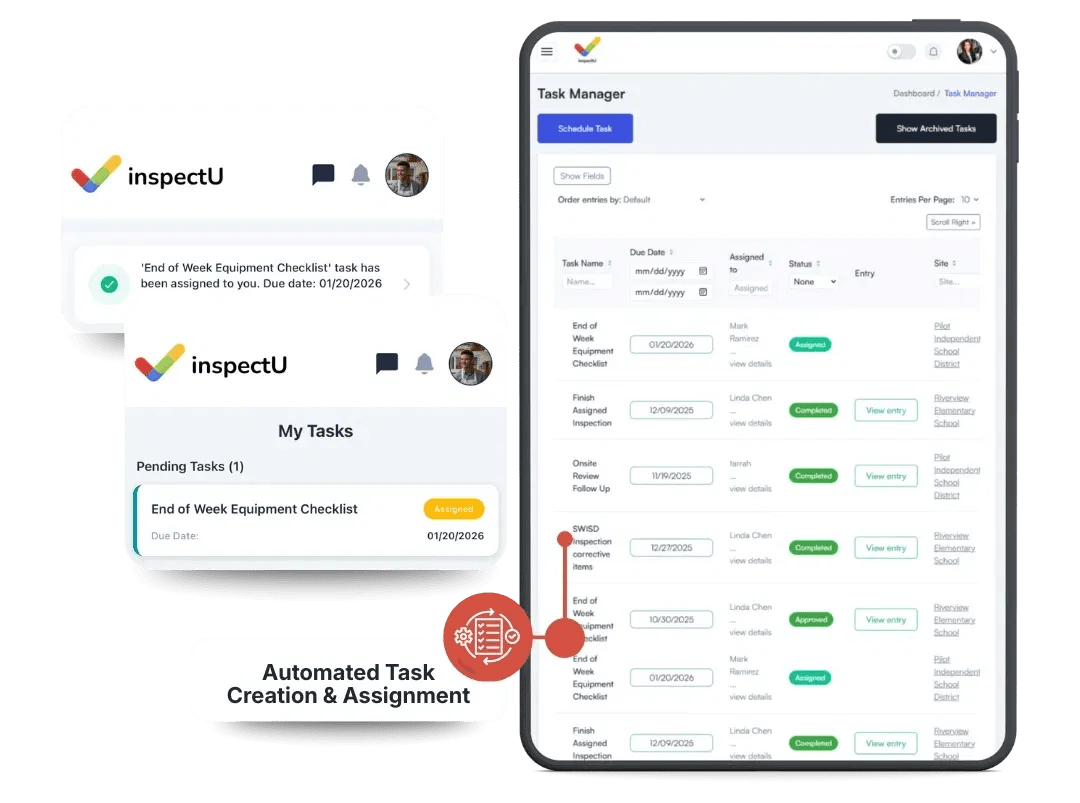
InspectU task management helps teams turn findings into assigned tasks, track progress, and document closeout.
One owner. One deadline. No ambiguity.
6. Track progress in one system
A corrective action should not disappear after the inspection report is submitted.
Track the action through clear statuses, such as:
- Open
- Assigned
- In progress
- Pending review
- Overdue
- Completed
- Verified
- Closed
Your team should be able to see upcoming deadlines, overdue items, stalled actions, and recurring findings without searching through separate files.
Centralized tracking also improves management visibility. Leaders can identify patterns across departments, sites, shifts, and assets. They can see whether delays result from staffing, purchasing, maintenance, training, or unclear procedures.
Paper records document history. Connected workflows help manage the work.
7. Verify effectiveness
Completion does not always mean effectiveness.
A task may be marked complete because a repair was made or a procedure was updated. Verification asks a more important question:
Did the corrective action solve the problem and reduce the chance of recurrence?
Choose a verification method before closing the action. Depending on the finding, this may include:
- A follow-up inspection
- A manager observation
- A document review
- A photo of the completed repair
- A training completion record
- An audit of similar areas
- A review of recurring finding data
- Worker or supervisor interviews
Record the verification date, verifier, evidence, and result.
If the action did not work, do not force closure. Reopen the item, revise the action, or create a new action that addresses the remaining risk.
Closed means verified: not merely checked off.
8. Close the loop and improve the program
Formal closure should confirm that:
- The corrective action was completed.
- Supporting evidence is attached.
- Effectiveness was verified.
- Residual risks are documented.
- Relevant procedures, checklists, or training materials were updated.
- The appropriate person approved closure.
Then use the information to improve future inspections.
If the same finding appears repeatedly, the problem may be broader than one location. Your team may need to review:
- Inspection frequency
- Checklist design
- Training requirements
- Preventive maintenance
- Staffing or scheduling
- Procurement standards
- Supervisor accountability
- Communication between departments
Every finding is data. Every trend is direction.
Free corrective action checklist
Use this checklist to standardize your corrective action process:
Finding details
- Finding ID or reference number recorded
- Date and time documented
- Exact location identified
- Inspector or reporting team identified
- Finding description is specific
- Applicable standard or checklist item recorded
- Photos or supporting evidence attached
- Related asset, department, or site linked
Risk and containment
- Risk level assigned
- Immediate hazard evaluated
- Temporary containment completed, if needed
- Containment action and date documented
- Escalation completed, if required
Investigation and planning
- Root cause identified
- Investigation considers process and system factors
- Corrective action addresses the root cause
- Action includes a measurable outcome
- One accountable owner assigned
- Firm due date established
- Resources or dependencies recorded
Implementation and verification
- Progress status updated
- Delays escalated
- Completion evidence attached
- Verification method defined
- Effectiveness verified
- Verification date and verifier recorded
- Additional action created if the solution was not effective
Closure and improvement
- Closure approved by the appropriate person
- Residual risk documented
- Related procedure or checklist updated
- Training or communication completed
- Similar locations or assets reviewed
- Finding included in trend analysis
Make corrective action management part of the workflow
A strong corrective action process should not depend on memory, follow-up emails, or disconnected spreadsheets.
InspectU connects inspections, findings, tasks, evidence, documents, training, records, and reporting in one platform. Teams can capture issues from any device, work offline when needed, assign corrective actions, monitor progress, and maintain an audit-ready record of resolution.
The result is straightforward:
Fewer disconnected steps. Clearer accountability. Better operational control.
Explore InspectU inspections and audits, connect findings to task management, and store supporting evidence in the Document Hub or Records Hub.
Every finding has a next step. Make sure your system shows it.
Comments (1)
[…] This structure creates consistency across schools, hotels, facilities, and other distributed operations. It also supports the closed-loop approach described in the InspectU corrective action framework. […]
Comments are closed.