Every school has classrooms to maintain, kitchens to operate, chemicals to manage, equipment to service, and employees working across multiple locations.
Every district safety team has inspections to complete, training to document, hazards to correct, and records to retrieve.
When that work is spread across paper forms, spreadsheets, email, and disconnected systems, visibility declines. A hazard may be identified without a clear owner. A training record may be difficult to locate. A completed inspection may provide no reliable path to corrective action.
That is the operational challenge behind K-12 OSHA compliance.
A strong program connects inspections, hazards, training, corrective actions, and records in one consistent workflow.
Important: OSHA coverage and requirements for public school districts vary by state. This guide is for operational planning and does not replace advice from your state OSHA authority, legal counsel, or a qualified safety professional.
Start with jurisdiction. Know which rules apply.
Public school districts are generally state or local government entities. As a result, they are not covered by federal OSHA in the same way as private employers.
The key question is whether your district operates in a jurisdiction with an OSHA-approved state plan that covers public employees.
According to OSHA’s state plan information:
- Some state plans cover both private-sector and state or local government employees.
- Other state plans cover only state and local government employees.
- In states without an approved plan covering public employees, districts may fall under separate state workplace-safety laws or public-employee safety programs.
- Private and parochial schools are generally treated as private employers and may be covered by federal OSHA or a state plan.
The practical takeaway is simple: do not assume that federal OSHA coverage: or a federal exemption: answers your district’s obligations.
Confirm:
- Which agency regulates public employers in your state.
- Whether your state plan covers local educational agencies.
- Which OSHA standards the state has adopted.
- Whether state rules are more specific or more stringent than federal requirements.
- Whether your district must maintain OSHA injury and illness logs.
Coverage first. Then control.
The standards most district teams need to manage
District operations are varied. A single safety program may cover custodians, maintenance employees, nurses, coaches, food service staff, teachers, transportation teams, grounds crews, and administrators.
The exact requirements depend on job duties and state rules. However, these areas commonly require written programs, inspections, training, or documented follow-up.
Hazard communication
Schools use and store cleaning chemicals, laboratory materials, maintenance products, fuels, pesticides, and other hazardous substances.
A practical Hazard Communication program should address:
- A current chemical inventory.
- Proper container labels.
- Safety Data Sheet availability.
- Written procedures for chemical handling and storage.
- Employee training before exposure or assignment.
- Training when new chemical hazards are introduced.
- Access to information in a language and manner employees understand.
Your district should be able to answer one question quickly:
Can an employee find the information needed to work safely with a chemical today?
Lockout/tagout
Maintenance, facilities, kitchen, and technical staff may service equipment with electrical, mechanical, hydraulic, pneumatic, thermal, or other hazardous energy sources.
A lockout/tagout program should identify:
- Equipment and energy sources.
- Authorized employees who perform servicing.
- Affected employees who work near the equipment.
- Shutdown, isolation, lock, tag, and verification procedures.
- Required training and retraining.
- Periodic inspections of energy-control procedures.
A written program is important. Documented application is stronger.
Personal protective equipment
PPE requirements should follow a documented hazard assessment. District teams may need to evaluate custodial work, science laboratories, maintenance areas, athletics, nursing spaces, grounds work, and food service operations.
Your program should document:
- The hazards identified by job or task.
- The PPE selected for each hazard.
- How employees receive and use PPE.
- Cleaning, storage, inspection, and replacement procedures.
- Employee training on fit, limitations, care, and proper use.
PPE is not a substitute for hazard elimination. It is one part of a complete risk-control process.
Bloodborne pathogens
Employees who may reasonably anticipate contact with blood or other potentially infectious materials may require specific protections. This can include nurses, custodians, coaches, athletic trainers, special education staff, and other school employees.
A bloodborne pathogens program commonly includes:
- A written Exposure Control Plan.
- Identification of job classifications with occupational exposure.
- Engineering and work-practice controls.
- PPE requirements.
- Hepatitis B vaccination procedures.
- Exposure response and post-exposure evaluation.
- Annual training where required.
- Retention of training and medical records according to applicable rules.
Keep the plan current. Review it when duties, staffing, equipment, or exposure conditions change.
Heat illness
Grounds crews, maintenance teams, athletic staff, transportation employees, and other outdoor workers may face heat exposure.
Federal OSHA does not currently provide one universal heat illness standard for every workplace. State requirements and enforcement approaches vary. Some states have specific heat illness rules, while others use guidance, emphasis programs, or general safety obligations.
District heat programs should consider:
- Drinking water.
- Rest and recovery opportunities.
- Shade or cooling areas.
- Acclimatization for new or returning employees.
- Supervisor response procedures.
- Training on symptoms, prevention, and emergency action.
- Weather and work conditions at each location.
The right process depends on your state. The need for visibility does not.
OSHA 300 logs and injury records: verify the exemption
Many educational establishments are listed among industries that may be partially exempt from routine federal OSHA recordkeeping. Under federal rules, certain schools may not have to routinely maintain Forms 300, 300A, and 301 based on their industry classification.
That does not eliminate every obligation.
Districts may still need to:
- Report severe incidents within required timeframes.
- Respond to a written OSHA or Bureau of Labor Statistics request.
- Maintain records under a state plan or public-sector safety program.
- Follow state-specific requirements that remove or modify the federal exemption.
- Track incidents internally for risk management and prevention.
For example, a state may require public schools to maintain injury logs even when the federal rule would provide a partial exemption.
Use OSHA’s recordkeeping resources as a starting point, then verify the rule that applies to your district and each relevant establishment.
An exemption from one federal recordkeeping requirement is not an exemption from managing workplace risk.
Common gaps district teams discover
A district may have written policies and still struggle during an inspection, audit, claim review, or internal assessment.
The most common gaps are operational:
- A chemical inventory exists, but it is outdated.
- SDS files are stored in different locations.
- A training course was completed, but no usable record is attached.
- An inspection identifies a hazard, but no owner or due date is assigned.
- Corrective actions remain open without escalation.
- A written LOTO procedure does not match current equipment.
- PPE assessments are not organized by job or site.
- Training records are stored in individual email accounts.
- Injury information is maintained separately from safety inspections.
- District leadership cannot quickly see open hazards across locations.
These gaps are rarely caused by a lack of effort. They are caused by disconnected workflows.
Build a practical K-12 safety management program
A manageable program has four connected parts.
1. Standardize inspections
Create consistent inspection templates for:
- Custodial areas.
- Mechanical rooms.
- Science and laboratory spaces.
- Kitchens and cafeterias.
- Playgrounds and athletic facilities.
- Transportation and fleet areas.
- Chemical storage.
- Emergency equipment.
- PPE availability.
- Heat exposure conditions.
Use a mobile inspection app so employees can complete inspections where the work happens. InspectU supports mobile and web access, offline capture, photos, notes, standardized templates, and automatic synchronization when a connection is restored.

Consistent templates create consistent evidence.
2. Track hazards to closure
An inspection is only the beginning. When a hazard is found, the system should make the next step clear.
Assign:
- The responsible person.
- A priority.
- A due date.
- Supporting evidence.
- A status.
- Verification requirements.
InspectU can turn findings into corrective-action tasks connected to the original inspection. Teams can monitor progress, document completion, and identify overdue items without rebuilding the process in a separate spreadsheet.
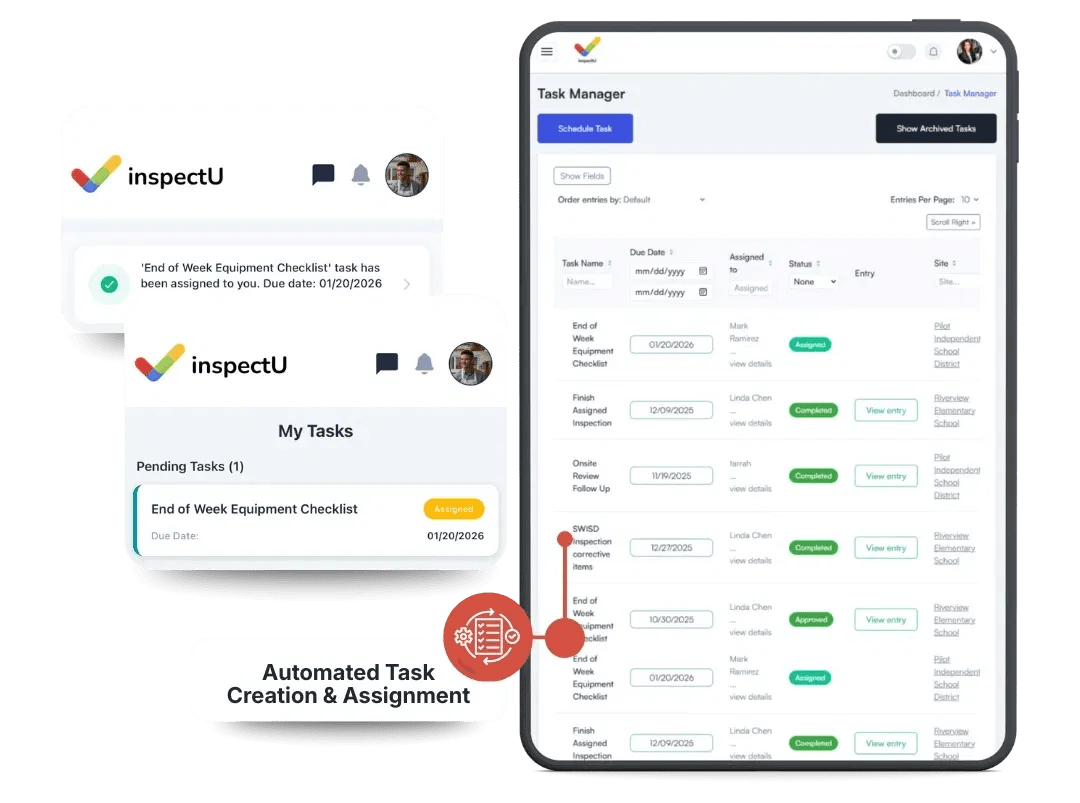
Assign, track, verify, and close out.
3. Document training
Training records should show more than a course title. They should help your team confirm who was trained, when training occurred, what topic was covered, and whether retraining is due.
Use a centralized training process for topics such as:
- Hazard Communication.
- Lockout/tagout.
- PPE.
- Bloodborne pathogens.
- Heat illness prevention.
- Emergency response.
- Laboratory and chemical hygiene.
- Job-specific equipment safety.
InspectU’s training management capabilities help districts assign courses, monitor completion, and maintain a clearer view of employee readiness.
4. Keep records audit-ready
Safety records should be organized before someone requests them.
A practical record system may include:
- Inspection reports.
- Corrective-action evidence.
- Training records.
- Written safety programs.
- Exposure control plans.
- PPE assessments.
- Chemical inventories.
- SDS documentation.
- Injury and incident records.
- Equipment and maintenance records.
The InspectU Document Hub and Records Hub support centralized access to important compliance information. Instead of searching through binders, email threads, and local drives, teams can build one organized source of operational records.

Ready records. Faster answers. Better control.
Use technology to strengthen: not replace: the safety program
Safety inspection software does not replace qualified safety professionals, employee participation, or state-specific guidance.
It does provide structure.
With InspectU, district teams can:
- Replace paper inspections with digital workflows.
- Use prebuilt templates or create district-specific forms.
- Capture evidence from any device.
- Continue inspections offline.
- Generate corrective-action tasks automatically.
- Assign owners and due dates.
- Monitor open issues across sites.
- Document training completion.
- Centralize records and inspection history.
- Produce clearer reports for leadership and auditors.
That connected approach supports stronger K-12 risk management. It gives safety teams a current view of what was inspected, what was found, what remains open, and where attention is needed next.
A district-ready compliance checklist
Use this checklist to begin reviewing your program:
- Confirm your state’s public-sector OSHA coverage.
- Identify the agency with inspection or enforcement authority.
- Review Hazard Communication procedures and chemical inventories.
- Verify SDS access at each location.
- Review lockout/tagout procedures and employee designations.
- Complete and document PPE hazard assessments.
- Maintain the Bloodborne Pathogens Exposure Control Plan where applicable.
- Review heat illness procedures for outdoor and high-heat work.
- Confirm OSHA 300, 300A, and 301 requirements for your jurisdiction.
- Standardize inspections across sites.
- Assign every hazard to an owner with a due date.
- Document corrective-action closure.
- Track required training and retraining.
- Centralize records for fast retrieval.
Compliance is not a binder on a shelf. It is a working system.
The strongest district safety programs connect standards to daily actions: inspect consistently, identify hazards, assign responsibility, verify completion, document training, and keep records current.
When those steps are connected, your team gains clarity, accountability, and control across every school and facility.
SEO details
SEO title: K-12 OSHA Compliance: A Practical Guide for District Safety Teams
Meta description: Learn how school districts can manage K-12 OSHA compliance, safety inspections, training, corrective actions, injury records, and audit-ready documentation.
Focus keyword: K12 OSHA compliance
Tags: K12 OSHA compliance, safety inspection software, K12 risk management, compliance tracking software, mobile inspection app, school safety, school district compliance, OSHA 300 logs, hazard communication, lockout tagout, PPE, bloodborne pathogens, heat illness prevention